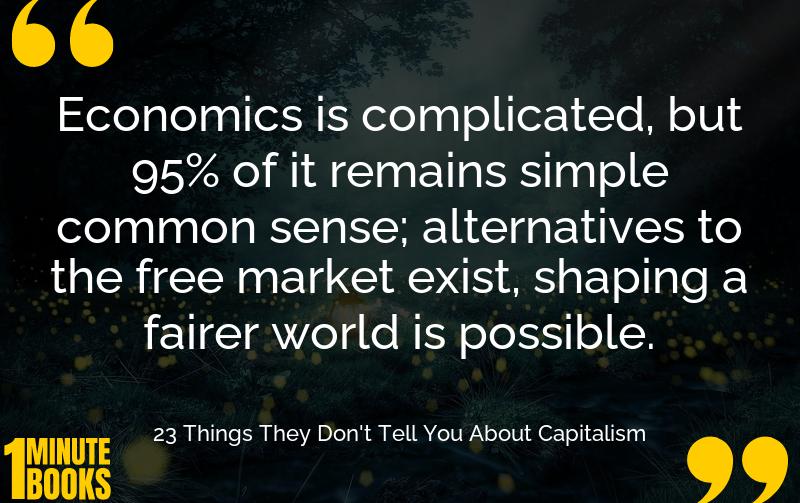
This book challenges the myths of free market capitalism, revealing misunderstandings in economic theory. It advocates for alternative approaches to make the economy fairer and more stable.
Main Lessons
- Free market capitalism is not inherently objective or scientific; it’s laden with complexities.
- Individuals are not always rational actors; bounded rationality affects decision-making.
- Altruism influences economic behavior as much as self-interest does.
- Market wages do not necessarily reflect a person’s true worth or contribution.
- A robust manufacturing sector is key for strong economic growth.
- The financial crisis arose from high-risk, complex financial derivatives.
- Government economic intervention can be beneficial when handled strategically.
- Social welfare programs can drive economic growth by supporting entrepreneurial risk-taking.
- Western policies may not always suit developing countries; tailored solutions are needed.
- The problem isn’t capitalism itself, but the unchecked free market version.
- Introducing bounded rationality to capitalism could allow more regulated, safer economic choices.
- Government can guide capitalism effectively by setting goals, not overpowering regulation.
- The knowledge economy is overvalued; manufacturing yields faster productivity growth.
- Trickle-down economics often fails to deliver promised economic improvements.
- Proper design of capitalism is essential to harness its benefits while minimizing risks.