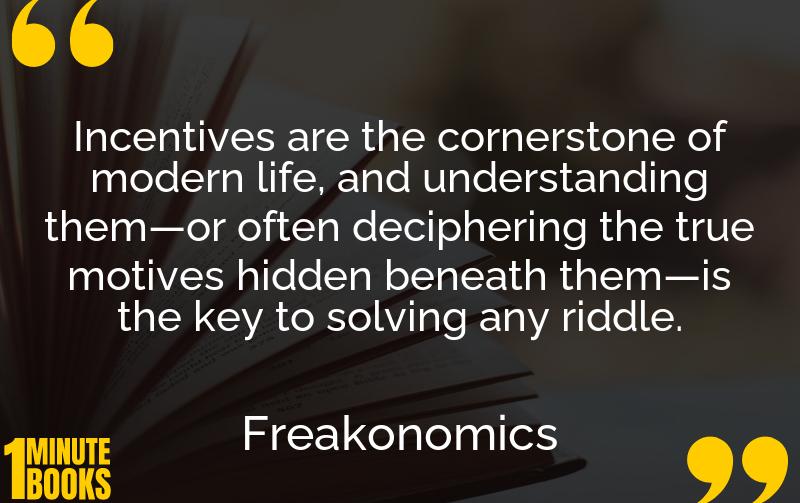
Freakonomics explores how economic principles apply to everyday problems, uncovering hidden truths and challenging conventional wisdom through diverse real-world examples like cheating, crime, and parenting.
Main Lessons
- Incentives drive behavior, and understanding them is crucial to predicting outcomes.
- Economic, social, and moral incentives often interact and influence one another.
- Cheating can result from high-stakes competition, as shown in education and sports.
- Information asymmetry can lead to imbalances, as illustrated by real estate brokers’ behavior.
- Crime economics is complex, with street gangs’ financial structures mirroring corporate hierarchies.
- Long-term societal changes, such as legalized abortion, can have unforeseen impacts on crime rates.
- Conventional wisdom about parenting is often disproven, showing parents’ limited influence on children’s success.
- Name trends reflect and influence social dynamics but don’t determine success.
- Economic principles offer insights into various fields beyond financial markets.
- Questioning conventional wisdom can reveal unexpected truths about societal norms.
- Simple data analysis can address complex social questions, revealing hidden patterns and solutions.
- Human behavior is often more rational and driven by incentives than it appears on the surface.
- Understanding hidden incentives illuminates how seemingly unrelated phenomena connect.