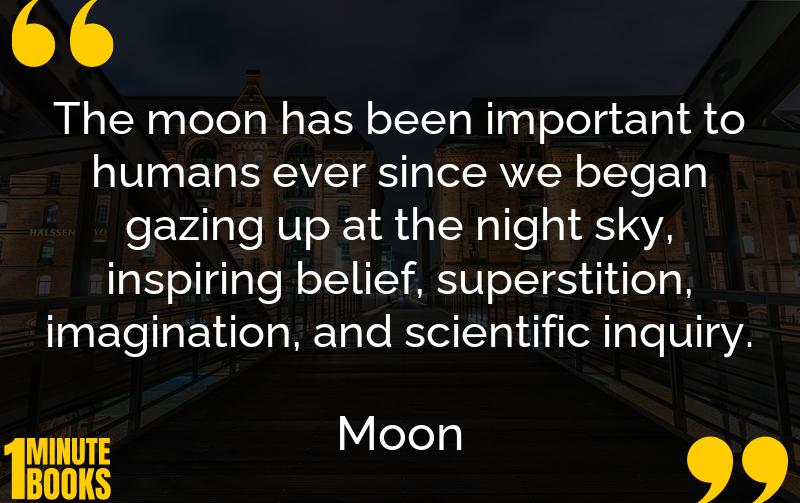
Ben Moore’s ‘Moon’ explores humanity’s fascination with the moon, from ancient myths to modern science and its future potential for exploration.
Main Lessons
- The moon has been central to human myth and science, captivating cultures across epochs.
- Despite past moon landings, its formation remains a mystery, driving current scientific interest.
- There’s renewed focus on lunar exploration for tourism, mining, and potential bases.
- Early Greek scientists were pivotal in debunking supernatural moon myths.
- Science fiction inspired real scientific advances in lunar travel, shaping future possibilities.
- The U.S.-Soviet Space Race was a catalyst for moon exploration, influencing scientific progress.
- Apollo missions contributed crucial data, expanding our understanding of the moon’s surface and composition.
- Impact models theorize the moon’s origin, although debates continue over its accuracy.
- The moon’s gravitational pull influences marine life but has little effect on human physiology.
- A lunar base could revolutionize scientific research, space travel, and Earth’s monitoring capabilities.
- Future moon bases may serve as stepping stones for deeper space exploration, like missions to Mars.