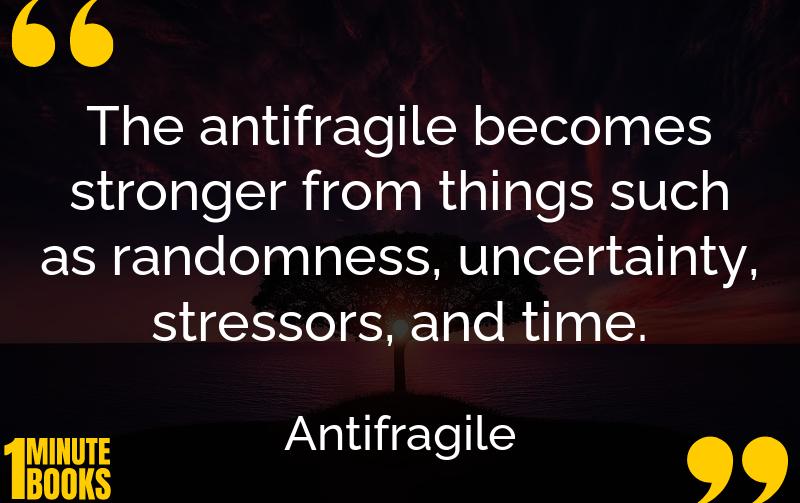
Antifragile delves into how systems, phenomena, and concepts can thrive and grow stronger from chaos and disorder. Taleb explores the nature of antifragility, contrasting it with fragility and robustness, and offers insights on navigating unpredictability effectively.
Main Lessons
- Distinguishing traits: Fragile things break from stress, robust things resist, and antifragile things grow stronger.
- Naive interventionism can turn antifragile systems fragile, as seen in overprotection in childhood.
- Nonlinear response helps detect antifragility; positive stressors amplify benefits.
- Redundancy minimizes fragility, as seen in nature’s dual organ systems.
- Optionality, like diverse investments, leverages unknowns for potential gain.
- The barbell strategy balances risk by securing against huge losses and exposing to large upsides.
- Antifragility thrives on randomness, time, and variation, encouraging resilience.
- The Lindy effect suggests longevity indicates robustness and perhaps antifragility.
- Black Swan events can’t be predicted, but systems can be structured to benefit or remain unaffected.
- Resistance to intervention maintains positive survival traits.
- Convexity and concavity show fragile and antifragile systems’ responses to stressors.
- Valuable systems aren’t average; variance in responses matters more.
- Investments should prioritize no-loss strategies, reflecting antifragile principles.