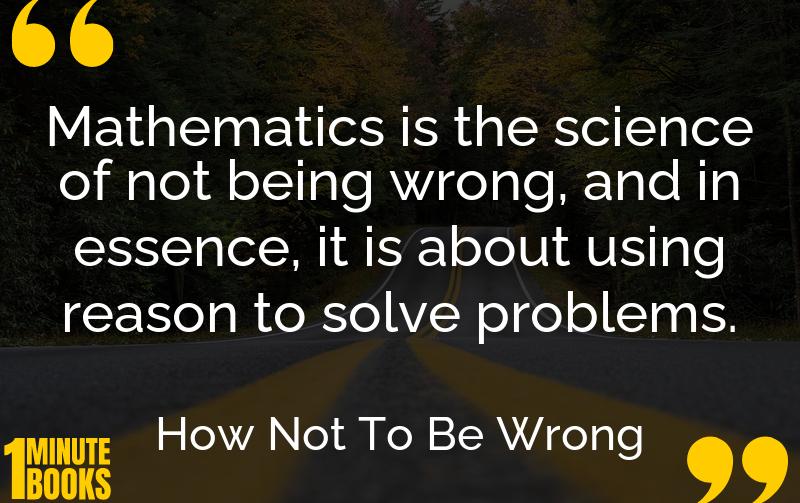
Jordan Ellenberg’s ‘How Not to Be Wrong’ explores how mathematical principles guide decision-making, problem-solving, and understanding in everyday life. It emphasizes math’s intuitive nature and practical applications.
Main Lessons
- Math is a tool for solving real-life problems and a reflection of our intuition and common sense.
- Understanding survivorship bias helps us avoid making judgments based on incomplete data.
- Linear regression simplifies complex data and helps identify trends, but beware of its limitations.
- Probability theory is crucial for predicting outcomes in uncertain situations, emphasizing expectation and risk assessment.
- The regression effect explains why outcomes often return to normalcy, showcasing randomness in various fields.
- Public opinion polls can oversimplify issues, misleading through majority rules and disregarding complexities.
- Published research can be swayed by statistical manipulation, affecting the credibility of findings.
- Probability predictions require critical evaluation of associated risks before making decisions.
- Math’s practical importance proves it is embedded in daily activities, though often unseen.
- Statistical significance can mislead; real understanding requires awareness of broader data constraints.
- Appreciating math’s role in daily life encourages informed decision-making and risk assessment.
- Avoid misinterpreting regression effects as causes; randomness often explains repeated outcomes.
- Data analysis is powerful but must be applied carefully considering the context of datasets.