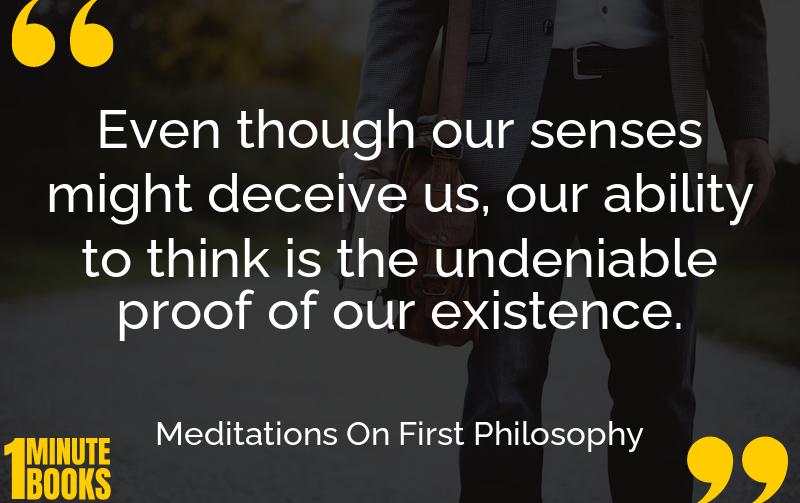
This book explores the complexities of perception, skepticism, and existence, emphasizing that while our senses can deceive, our thoughts confirm our being.
Main Lessons
- Our senses are unreliable and can be tricked, suggesting skepticism towards knowledge based solely on sensory experience.
- Thinking is the only certain proof of our existence, as our thoughts can’t be deceived.
- By questioning our senses, we strengthen our ability to think and perceive reality.
- Our mind fills gaps left by unreliable senses, proving our existence through independent judgment.
- Despite unreliable senses, they still contribute to our understanding of the world.
- A supreme thinking entity, God, is posited as the cause of our innate ability to think.
- The concepts understood by the mind alone signify the highest form of reality.
- Mind and body exist on distinct levels, with the mind being the superior entity.
- The mind or soul can potentially exist beyond bodily death.
- Skepticism drives us to trust our capacity to think as the true proof of existence.
- The book challenges readers to reconsider the reliability of their perceptions.
- Unsupported by sensory deception, our minds’ insights point towards deeper truths.
- There exists a critical relationship between mind, body, and a higher power.
- Our capacity for independent thought highlights the potential to transcend physical limits.