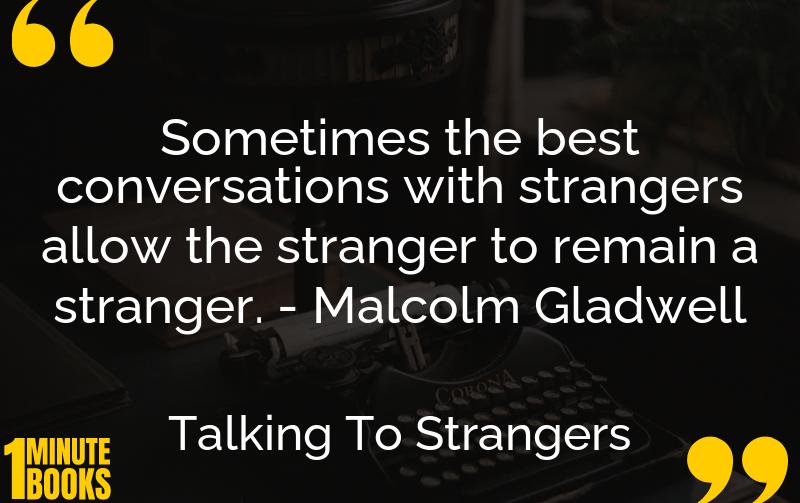
Malcolm Gladwell’s “Talking to Strangers” explores why we often misjudge strangers and how this impacts our interactions. Through historical examples and psychological studies, he reveals inherent biases and the challenges of interpreting behavior.
Main Lessons
- We overestimate our ability to read others’ thoughts and emotions accurately.
- Humans are inherently biased to believe others are truthful.
- Diverse expressions of emotions make judging accurate thoughts difficult.
- Recognition of personal biases is crucial for better interactions.
- Facial expressions and actions aren’t always true indicators of emotions.
- Historical examples, like Neville Chamberlain’s misjudgment of Hitler, illustrate misinterpretations.
- Trust speakers based on evidence, not intuition or assumption.
- Artificial intelligence can outperform human judgment in some cases.
- Constructive conversation acknowledges complexity and diversity in people’s experiences.
- Lessons from psychological studies reveal our perception limitations.
- Understanding misjudgments can improve legal, social, and personal decision-making.
- Misinterpretation can lead to significant, unforeseen consequences.
- Transparency in facial expressions is often misunderstood.
- Personal interactions require patience and toleration.
- Knowing your biases helps in reacting more appropriately.