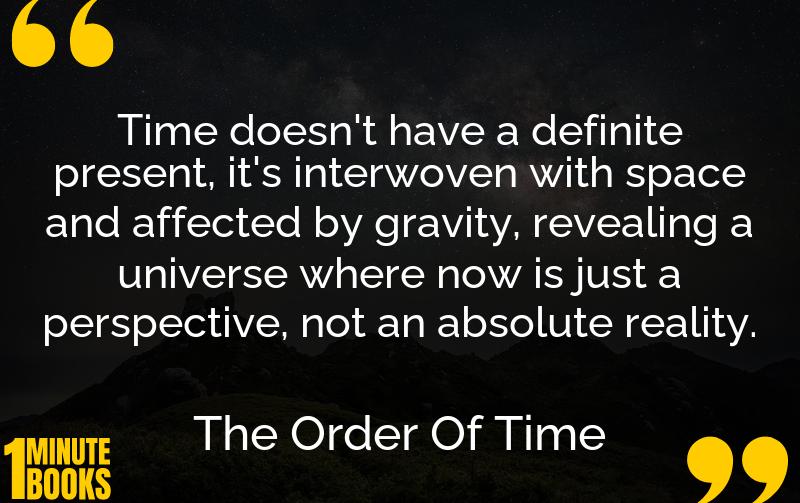
Carlo Rovelli explores the complex nature of time, dismantling common perceptions and revealing its links with space, gravity, and entropy. The book challenges our fundamental understanding of time’s flow and existence.
Main Lessons
- Time is not a uniform flow; it varies depending on factors like gravity and speed.
- Space and time are interwoven, forming the fabric of the universe.
- Our perception of now is subjective and changes with perspective.
- Entropy plays a crucial role in the existence of time, giving it direction.
- Time is linked to events rather than objects; everything is temporary.
- The passage of time is deeply intertwined with the second law of thermodynamics.
- The present is not an absolute reality but a relative concept.
- Memory organizes our perceptions of past, present, and future.
- Time emerges from our unique perspective of the universe.
- Entities like mountains or names are mere organizational constructs for our understanding.
- Gravity affects time, causing it to slow near massive objects.
- Movement at high speeds results in time passing more slowly.
- The universe is a collection of processes, not static objects.
- Our understanding of time is limited by language and perspective.
- Time may not even exist everywhere, especially in the context of black holes.