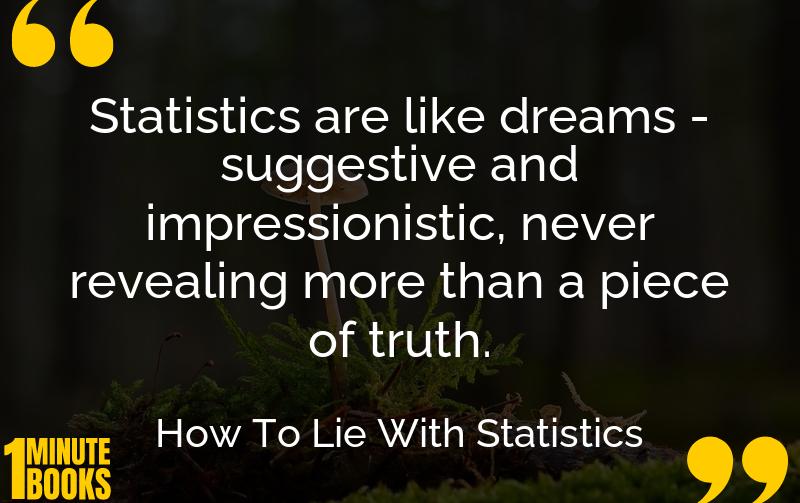
Darrell Huff’s book unveils the manipulative ways statistics can be used to deceive. It educates readers on identifying biased statistics and navigating through misleading data, empowering them to question statistical claims.
Main Lessons
- Sampling is crucial; a truly random sample is nearly impossible to achieve but essential for valid conclusions.
- Non-random samples often lead to sample bias, affecting the accuracy of conclusions drawn.
- The term ‘average’ can be misleading; it’s critical to question what is being averaged and who is included.
- Significance bias arises from small sample sizes, which can lead to misleading dramatic results.
- Standard error calculation is vital to accurately interpret results like IQ tests.
- Comparisons between unrelated figures can create misleading semi-attached figures.
- The post-hoc fallacy confuses correlation with causation, leading to erroneous conclusions.
- Question statistics critically to uncover common tricks used by marketers and advertisers.
- Being aware of statistical manipulation helps you to not fall prey to biased or incorrect information.
- Always be skeptical of statistical claims and ensure they have a logical basis before accepting them.