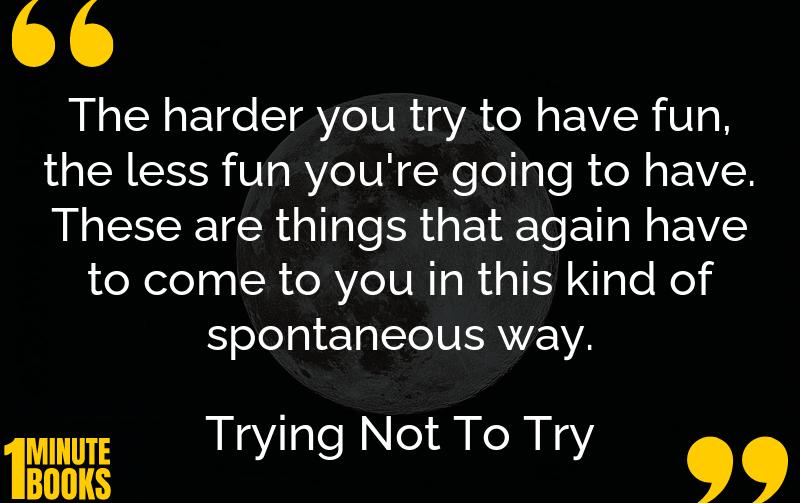
Trying Not to Try explores the paradox of achieving goals by letting go of control. It draws insights from Chinese philosophy on how spontaneity, absorption, and trust lead to success.
Main Lessons
- Effort can be counterproductive; sometimes success comes through spontaneity.
- Hot cognition allows for intuitive, unconscious actions that contribute to being in ‘the zone.’
- Cold cognition refers to slow, deliberate thinking that often creates internal conflict.
- The paradox of ‘trying not to try’ involves relaxing while maintaining purpose.
- Daoism and Confucianism offer strategies to balance effortlessness with action.
- Woo-wei is an effortless action state where one loses self-consciousness and performs optimally.
- Charisma and trust can emerge from genuine spontaneity and emotional authenticity.
- Societal emphasis on striving from an early age can hinder natural learning and creativity.
- Embodied cognition suggests thinking involves the entire body, not just rational thought.
- Strategies to bypass the paradox include carving and polishing, or relaxing and letting go.
- Various life stages and personality traits may require different strategies to achieve woo-wei.
- Engagement with Chinese thought highlights the importance of embodied imagination and emotional training.
- A balance between abstraction and embodied experiences can offer solutions to complex problems.